
How fast is the move to phone-free classrooms?
In March 2026, UNESCO's Global Education Monitoring team counted 114 education systems with a national ban on phones in schools, 58% of countries. In June 2023 the share was 24%.
The two biggest English-speaking markets got there by different routes:
- England. The Department for Education's guidance says "all schools should be mobile phone-free environments by default". It became statutory on 29 June 2026, and schools follow it from 1 September 2026. Sixth forms may allow limited access.
- United States. There is no federal ban. UNESCO counts 39 states with either a statewide ban (15) or a rule that districts must restrict phones (24). ExcelinEd tracked 28 states that passed phone-free classroom or school policies in 2025 alone, some "bell to bell", some for instructional time only.
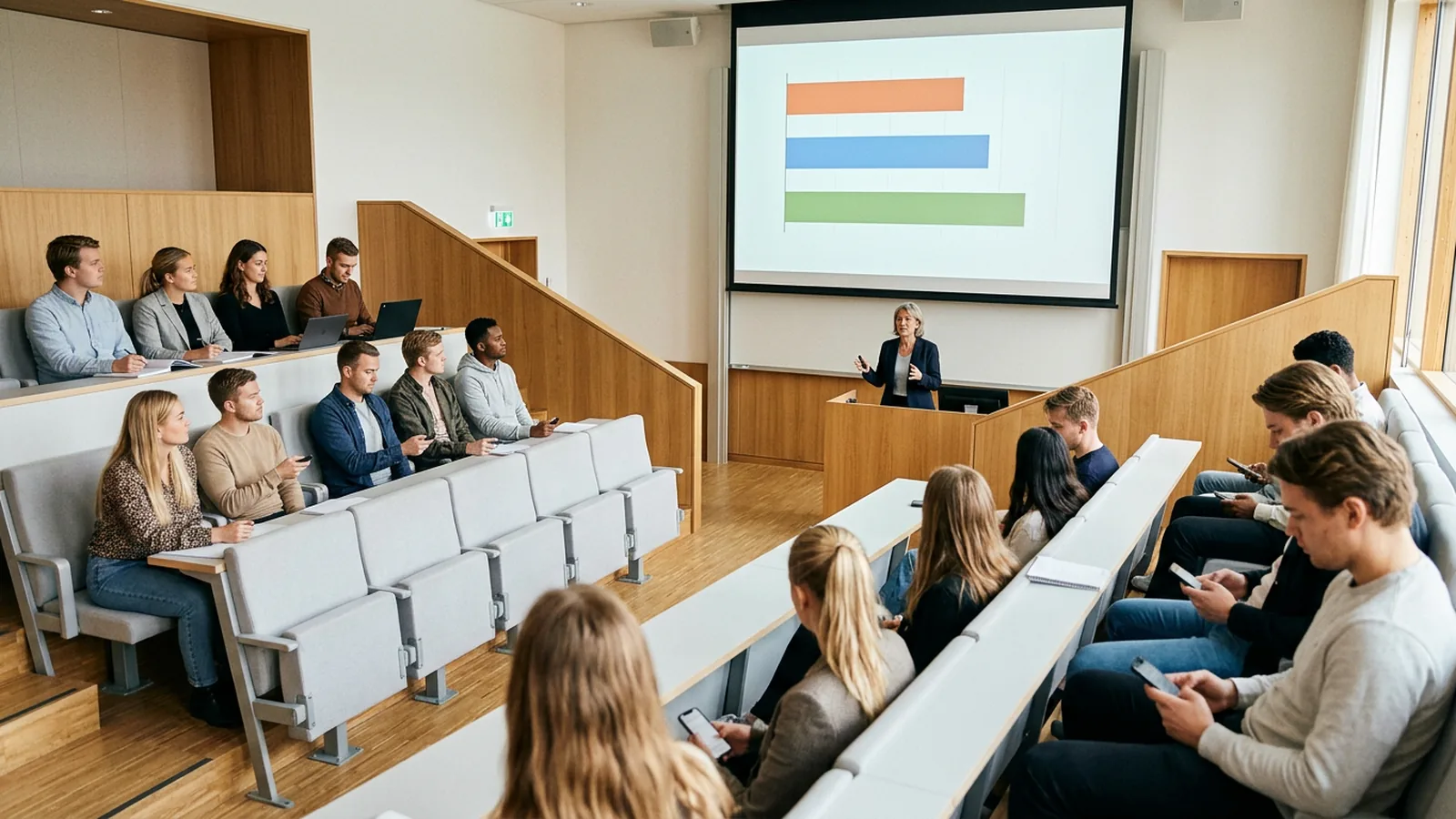
Neither country's rules cover universities, so in a lecture hall or lecture theatre the call is still the lecturer's.
Why are countries going back to printed books and less screen time?
Sweden had gone further than most toward digital classrooms, and then turned back. In November 2023 the Swedish government dropped the national agency's proposed digitalization strategy and said the focus for younger pupils should be physical books, with digital tools used selectively and only where there is clear scientific support. In February 2024 it set aside 658 million kronor for about 1.3 million textbooks, aiming at one textbook per pupil and subject. From the start of the 2026 school year, a national ban applies for the whole school day: phones are handed in in the morning and returned when school ends.
UNESCO's 2023 report on technology in education, A tool on whose terms?, says in its summary that "there is little robust evidence on digital technology's added value in education", that PISA data suggest "a negative link between excessive ICT use and student performance", and that mere proximity to a mobile device was found to distract students in 14 countries.
What does the research say about phones, attention and screen fatigue?
Six findings, and where each one is contested.
Distraction from other people's devices is linked to lower scores. In the OECD's PISA 2022 results, about one in four students across OECD countries said they get distracted by other students using digital devices in most or every math lesson. Students who reported this in at least some lessons scored 15 points lower in mathematics than those who said it never or almost never happens, after accounting for socio-economic background. This is a correlation, not proof of cause.
Laptops in class can hurt the people sitting nearby. In a simulated lecture, students who multitasked on a laptop scored lower on a comprehension test, and so did students who could see a multitasking peer's screen (Sana, Weston and Cepeda, 2013).
Bans help some students more than others. A study of schools in four English cities found test scores rose by 6.41% of a standard deviation after a phone ban, with the lowest-achieving pupils gaining 14.23% and the top quartile unaffected. Gains only showed where the ban was actually followed.
Bans alone did not change outcomes in another study. The SMART Schools study compared 1,227 pupils in 30 English secondary schools. Restrictive schools cut phone use during the school day by about 40 minutes, yet the authors found no evidence of better mental wellbeing, sleep or attainment compared with permissive schools.
The "brain drain" effect is contested. Ward and colleagues found in 2017 that, across nearly 800 people, having your own phone on the desk reduced available cognitive capacity, even face down and switched off. Two direct replications did not reproduce it. A 2024 meta-analysis found a small negative effect on working memory only, with null results for other cognitive functions.
Handwriting versus typing is mixed too. An EEG study of 36 university students found far richer brain connectivity when writing by hand than when typing. A published commentary points out that the task involved no learning, so it cannot show that handwriting helps people learn. A direct replication of the famous 2014 "pen is mightier than the keyboard" note-taking study found small, non-significant effects favoring longhand and called the question premature to settle.
Do device-free meetings and training sessions work the same way?
The adult version of the problem is multitasking. A Microsoft study of remote meetings found about 30% of meetings involved email multitasking, and the odds rose with meeting length and size: in meetings over 80 minutes, the odds of email multitasking were 6.21 times those of meetings under 20 minutes. People said they multitask more in meetings they find irrelevant.
Colleagues do not all agree on what is acceptable. A nationwide survey of 350 US business professionals found large differences by age, gender, region and income, with men nearly twice as likely as women to accept phone use in informal meetings.
A device-free rule makes sense for a board meeting, an AGM or annual meeting, a town hall or a training day. The catch is the same as in school: if the only way to vote, rate a session or answer a quiz is "take out your phone and scan this code", the rule breaks the moment you need input. For more on keeping a training room involved, see our guide to training session engagement.
If phones are out, how does everyone still get a voice?
Taking phones away does not make anyone answer. Without a response tool, the same few hands go up. Active participation is where the learning gains are: a meta-analysis of 225 studies in undergraduate science, engineering and maths found students in traditional lectures were 1.5 times more likely to fail than students in classes with active learning (33.8% versus 21.8%).
Phone-free ways to hear from everyone, roughly from simplest to most structured:
- Hands up, with a twist. Ask everyone to commit at once: fingers for A, B, C or D, held against the chest so neighbours cannot copy.
- Mini whiteboards. Everyone writes, everyone holds up. Works for short answers, hard to count in a room of 200.
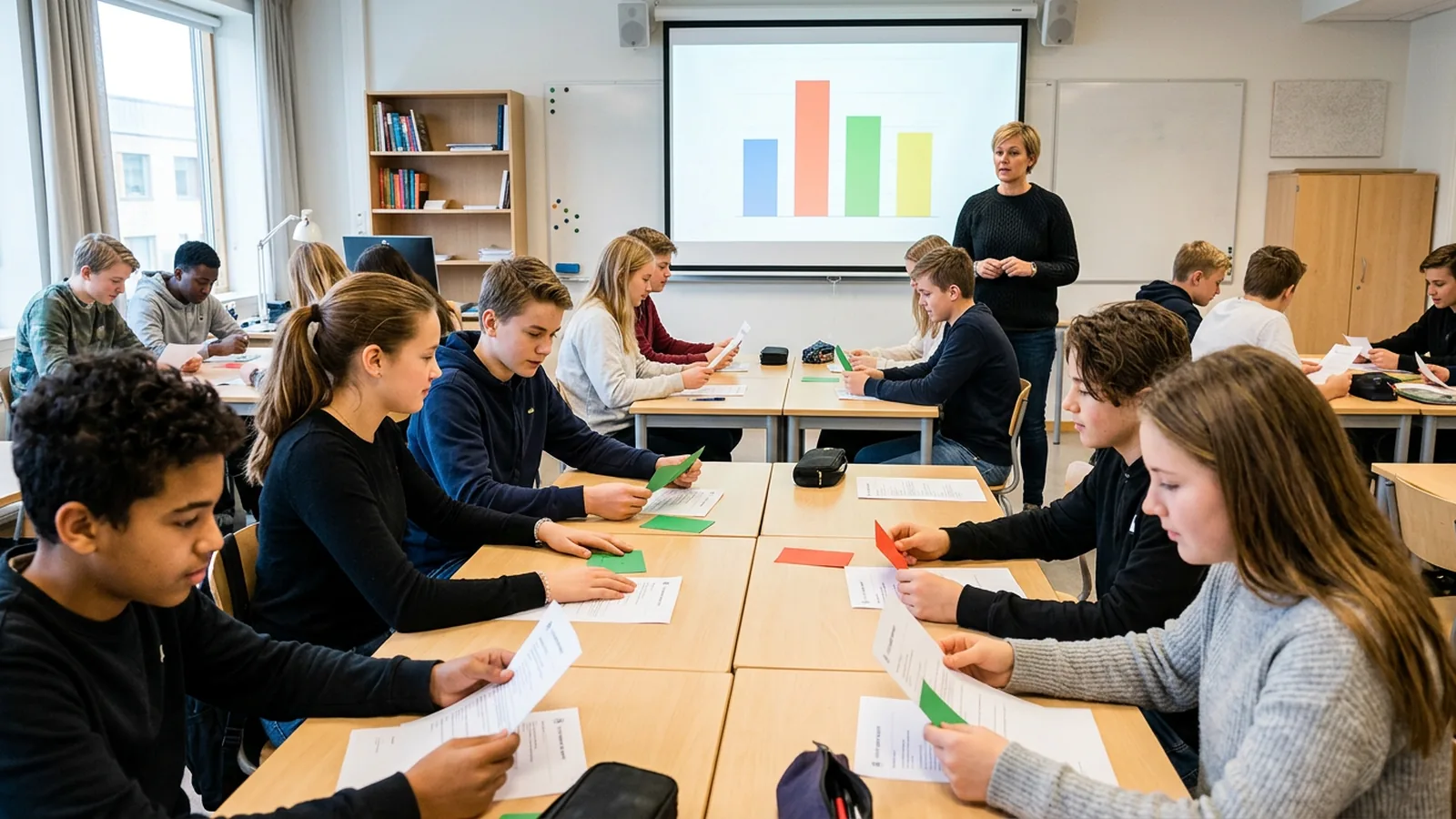
- ABCD cards. Print one set per student and reuse it all year. You see the room, but you cannot keep the results.
- Clickers (voting handsets or keypads). Everyone presses a key, you see a counted chart, and you can keep the data.
Our sibling article on phone bans and interactive lessons compares these methods in more detail.
Why do single-purpose devices fit a phone-free room?
Opening a phone to give one answer also opens the lock screen, the notifications and the feed. A single-purpose device does one job and then goes quiet.
The ResponsePad that OMBEA makes has no screen, no apps and no notifications: ten keys, A to J, and a light that tells each person their answer is in. It talks by radio to a ResponseLink receiver plugged into a USB port, so there is no Wi-Fi, no app download and no log-in. Batteries last about three years.
The limits:
- It is not screen-free. The results show on the projector screen at the front. What goes away is the screen in every lap.
- Clickers do not do free text. For word clouds and open answers, phones are better. Our clickers or phones guide covers when to use which.
- You hand out and collect hardware. Keep the set in a case by the door, like the phone box.
With OMBEA Response, a question is a normal PowerPoint slide in the deck you were already going to show, so there is no extra platform to learn. The chart fills in live as people press their keys. The features page lists the question types.
How do I run a phone-free session tomorrow?
This works in a high school class, a secondary school lesson, a 300-seat lecture or a half-day training.
- Say the rule at the start. "Phones in bags, face down, or in the box. You will not need them."
- Plan three to five moments where you need everyone's answer. A starter question, one or two hinge questions where the next step depends on the answer, and an exit question.
- Write each as a multiple-choice question with one tempting wrong answer. The wrong answer is where the discussion comes from.
- Ask everyone to answer before you show anything. With cards or fingers, count to three. With clickers, wait until the response count stops climbing.
- Show the result, then ask "who wants to argue for B?" Let people talk to a neighbour for one minute, then ask again and compare.
- Use anonymity on purpose. For a sensitive vote or honest feedback on a session, make answers anonymous and say so out loud.
- Keep one question for the end of term or semester. Ask it again in the last week and show both charts side by side.
For schools, our schools page and higher education page show how this looks in a classroom and a lecture hall. For boards and assemblies, see meetings and voting.
Bring hands back up in your room
Planning a phone-free classroom, lecture hall or meeting? Tell us how many people and rooms you have, and we will put together a quote with the right number of clickers and receivers.