
Do icebreakers actually help meetings?
In a survey of 252 working adults, Allen, Lehmann-Willenbrock and Landowski (2014) found that small talk before a meeting was a significant predictor of how effective people judged the meeting to be, even after accounting for good meeting procedures. The link was stronger for less extraverted people.
The study measured how effective people felt the meeting was, not what it produced. So keep the opener short and impersonal, and let people answer in one word if they prefer.
What makes a good icebreaker question?
- Answerable in 10 seconds. If people have to think hard, save it for the agenda.
- No right answer and no risk. Nobody should have to reveal anything about health, family, money or beliefs.
- Inclusive across cultures and countries. Avoid questions that assume shared holidays, sports or TV. "Favorite Thanksgiving dish" leaves out your UK colleagues; "best bank holiday plan" leaves out your US ones.
- Works for remote people too. In Great Britain, 28% of working adults hybrid worked between January and March 2025 (Office for National Statistics). Pick a question that people on a video call can answer as easily as people in the room.
- Ideally, linked to the meeting. "What's one word for how this project feels right now?" also gives you a first reading on the project.
Quick icebreaker questions for regular team meetings
One-minute openers for a weekly team meeting or staff meeting. Most work as multiple choice, so everyone can answer at once.
- Coffee, tea, or neither?
- Early bird or night owl?
- What's the best thing you ate this week?
- On a scale of 1 to 5, how is your week going?
- Which season would you keep if you could only have one?
- What's one small win from the last seven days?
- Window seat or aisle seat?
- Which app on your phone would you delete first if you had to?
- What's on your desk right now that shouldn't be?
- If today were a weather forecast, what would it be? Sunny, cloudy, stormy or fog.
- What did you learn this week, at work or outside it?
- Which superpower would save you the most time at work: teleporting, reading minds, or never needing sleep?
Icebreaker questions for large meetings, town halls and AGMs
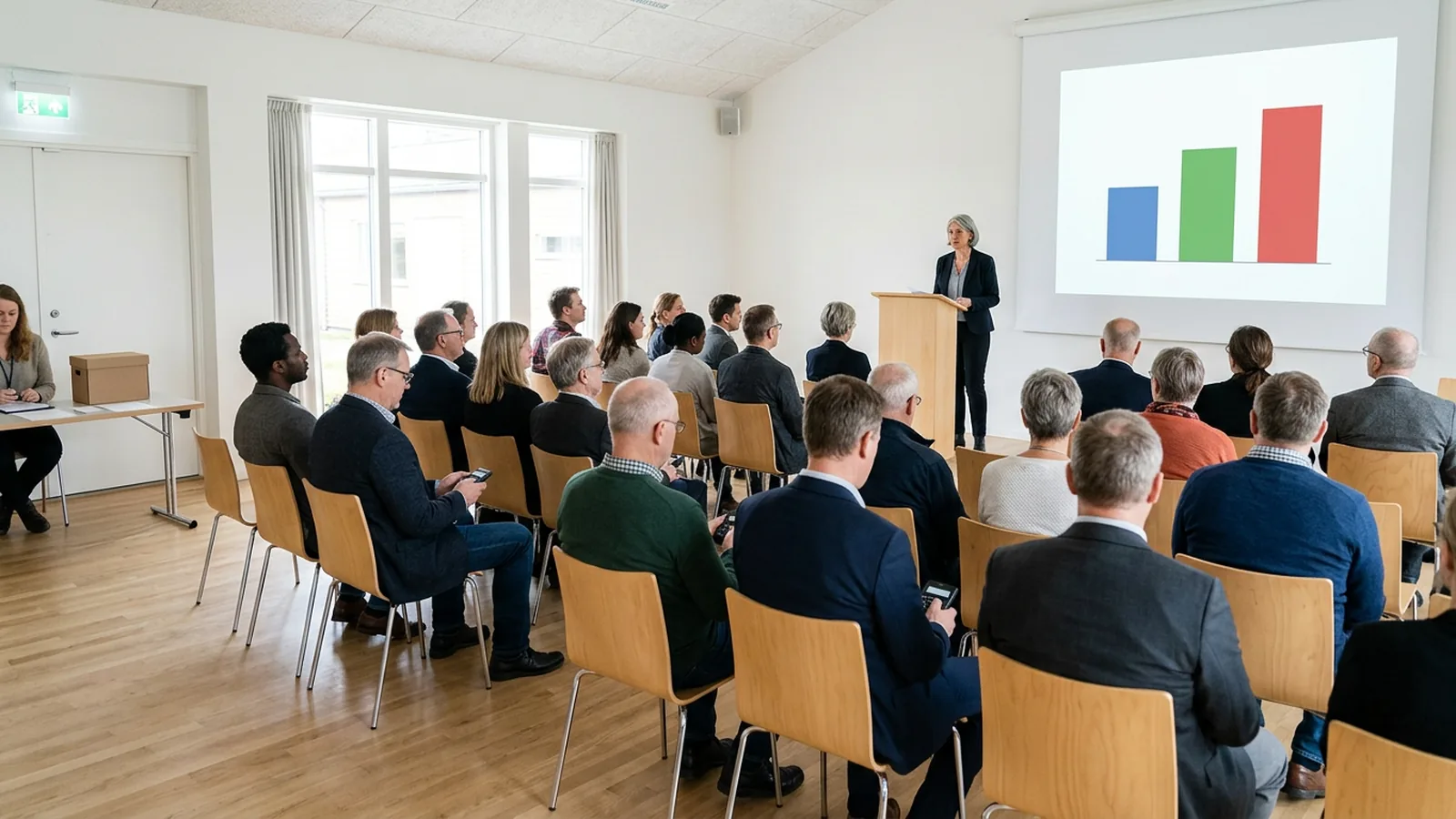
Ask these as multiple choice to the whole room, show the chart and comment on the result.
- How did you get here today? Car, train or bus, bike or walk, or I live upstairs.
- How many years have you worked here? Under 1, 1 to 3, 4 to 10, more than 10.
- Guess: how many people are in this room right now? (Then reveal the number.)
- Which decade's music would you play at the company party?
- What is the best meeting length? 15, 30, 45 or 60 minutes.
- Guess the result: what percentage of this room chose coffee? Then ask question 1.
- Which department do you think has the most plants?
- True or false: [a surprising fact about your organization]. Pick something you can confirm.
- How confident do you feel about this year's plan? A: Very. B: Fairly. C: Not very. D: Not sure what the plan is.
- For annual meetings of members or shareholders: Which topic on today's agenda matters most to you?
Question 21 is a business question in warm-up form. Asked anonymously, it tells leadership in minute two how confident the room is in the plan.
Icebreakers that open the meeting's topic
These lead into the agenda, so the warm-up is also the first item.
- In one word, how does this project feel right now?
- What's the one thing that must come out of today's meeting?
- Rate our progress on [goal] from 1 to 5.
- What would a customer say about [topic] if they were in the room?
- Which of these four risks worries you most? (List four.)
- What's one assumption about [topic] we should test?
- If we could only do one thing on today's agenda, which should it be?
- What did we get right last quarter, or last term if you're in a school?
- Finish the sentence: "This meeting is a success if…"
- What's slowing you down that the people in this room could fix?
Icebreaker questions for training sessions and workshops
In training, an opener can be a pre-test. Keep the answers and ask the same question at the end to show what changed. More on this on the corporate training page.
- How much do you already know about today's topic? Nothing, a little, quite a lot, I could teach it.
- Which of these statements about [topic] is true? (One true, three common myths.)
- What is the hardest part of [skill] in your job?
- Which situation do you face most often? (List four real scenarios.)
- What do you want to be able to do by the end of today?
- Where are you joining from? A: This building. B: Another office. C: Home. D: Somewhere more interesting.
- How did you learn the skill you are best at?
- What's the best piece of training you ever had, and why?
Getting-to-know-you questions for new teams
These take longer, so use them in pairs or groups of three or four, not in front of the whole room.
- What's a skill you have that most people here don't know about?
- What was your first job?
- What's a work habit you've picked up from a good manager?
- What do you wish people asked you about more often?
- Which tool or trick saves you the most time?
- What's something you're looking forward to this month?
- What's the most useful thing you've read or listened to this year?
- How do you like to receive feedback: in writing, face to face, or right away?
- What's one thing that makes a meeting good for you?
- What should a new colleague know about working with you?
How do you run an icebreaker with a large group?
At 30 seconds each, a round of 20 people takes 10 minutes and 200 people take 100. A poll takes about two minutes at any size:
- Pick a multiple choice question from the lists above. Four options is ideal.
- Put it on the first slide after the title.
- Give everyone 20 to 30 seconds to answer.
- Show the result and react to it: "Forty percent of you came by train. Who had the worst journey?"
- Invite two or three comments, then move on.
In a controlled study of simulated classes, Stowell and Nelson (2007) found that the group answering with clickers had the highest participation, followed by response cards, both significantly higher than hand-raising. The study was run with students, not employees, but the mechanism is the same in a meeting: pressing a key asks less of people than speaking up in front of the room.
Anonymous answers help with questions like 21 or 25, where people may not want their manager to see their answer.
You can run this with any polling tool. Phone-based tools work when everyone has a phone and the Wi-Fi holds. Clickers (also called keypads or voting handsets) work when it doesn't, or when you want phones in pockets. With OMBEA Response, the icebreaker is a normal slide in your PowerPoint deck and people answer on a ResponsePad, with no app or Wi-Fi. Anonymous mode means no answer can be linked to a person. See the meetings and voting page for how this works at board meetings and AGMs, and the features page for question types.
Which icebreaker questions should you avoid?
- Personal history: "Tell us about your family" or "your most embarrassing moment". People have reasons not to share.
- Questions with status attached: "Where did you go on holiday?" or "What car do you drive?"
- Alcohol-centered questions, which exclude people who don't drink.
- Forced physical activities in a business meeting, unless people opted in.
- Anything that takes over five minutes in a meeting under an hour.
How long should an icebreaker take?
A workable guide: two minutes for a 30-minute meeting, five minutes for a half-day workshop and up to 15 minutes on the first morning of a multi-day course. For more ideas on keeping people involved after the opener, see interactive presentation ideas and training session engagement.